
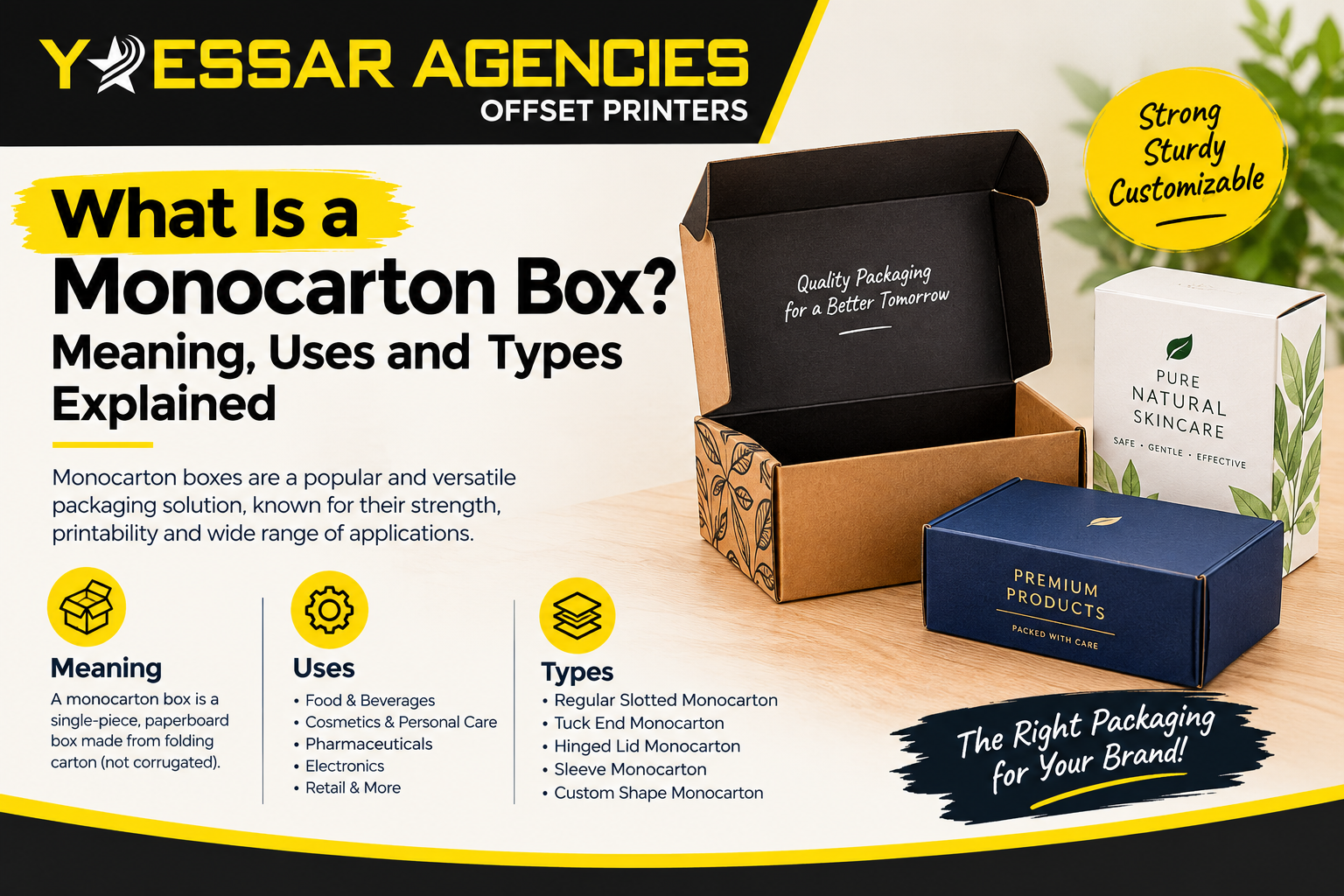
Walk down any pharmacy aisle or snack shelf and almost every box you touch started life as a flat sheet of printed paperboard. That sheet, cut and creased and folded into shape, is what the trade calls a monocarton. This guide explains what monocarton boxes are, how they are built, where they are used and how to choose the right type for your product.
A monocarton box is a folding carton made from printed paperboard, die-cut and creased from one flat sheet. It ships flat, folds into shape on the packing line, and holds products such as medicines, food, cosmetics and electronics. Brands choose it because it prints sharply, protects light goods and costs little per unit.
What Are Monocarton Boxes and Where Does the Name Come From?
The word monocarton is shorthand for a single-piece folding carton. Unlike a rigid gift box, which is assembled from several parts and wrapped in paper, a monocarton is cut from one sheet of paperboard, scored along fold lines, and glued at a single side seam. It reaches the packer as a flat, collapsed tube, and a machine or a person pops it open and closes the flaps.
Flat shipping explains why this format dominates retail packaging. A pallet of flat cartons carries far more units than a pallet of pre-formed boxes, so freight and warehouse costs drop. The box takes its shape only at the filling line, which keeps the printed surface clean until the last moment.
The names carton box, folding carton and monocarton overlap in everyday trade talk. Anyone comparing carton box manufacturing options usually want exactly this product: printed paperboard cartons made in bulk, as opposed to corrugated shipping cases. Corrugated boxes carry goods between warehouses, while monocartons face the shopper.
What Materials Go into a Monocarton?
Paperboard grade decides how a carton looks, feels and protects what is inside it. The two workhorses are folding box board (FBB), made from layered virgin pulp, and white-lined chipboard (duplex board), which has a recycled grey core and a white printable top. Weights usually fall between 230 and 400 GSM, with most retail cartons landing between 250 and 350.
| Board | Best for | Trade-off |
| FBB | Food, pharma, cosmetics | Costs more per sheet |
| Duplex board | Cereals, detergents, toys | Grey back shows inside |
| Kraft-back board | Natural-look retail packs | Duller print colours |
Food-grade cartons follow stricter material rules. Cartons holding biscuits, spices or sweets should use virgin-fibre board and low-migration inks, because mineral oil residues from recycled fibre can transfer into dry food. In India, food packaging falls under the FSSAI Packaging Regulations of 2018, and a good printer will confirm board and ink compliance before a job starts.
Surface finishes decide how a carton survives handling. Gloss and matt lamination add scuff resistance, aqueous varnish is a lighter, more recyclable option, and spot UV coating makes a logo shine against a matt background.
How Are Monocarton Boxes Made?
Production starts with the artwork, and the artwork has to match the die. A structural designer draws the carton outline with fold and cut lines, the graphic designer places text and images inside it, and the file is checked for bleed, safe margins and barcode size before a single plate is made.
Offset printing then lays the colour onto full sheets. Each of the four process inks (cyan, magenta, yellow and black) gets its own aluminium plate, and brand shades are added as Pantone inks. Sheet-fed offset presses hold colour steady across long runs, which is why they remain the default for carton printing.
Sivakasi has built its reputation on this kind of work. The Tamil Nadu town is one of India’s best-known printing centres, and offset printers there, Yessar Agencies among them, handle custom box printing for food and retail brands.
Die-cutting turns the printed sheet into a carton blank. A steel rule die, shaped like a cookie cutter, cuts the outline and presses crease lines in a single stroke, while stripping removes the waste around the edges. Poor die-making shows up later as cracked folds or flaps that spring open, so tolerance matters here.
A folder-gluer completes the process. It applies adhesive to one side panel, folds the blank over and compresses the stack so the seam sets flat. The cartons then travel to the customer flat, ready for the filling line.
Which Carton Styles Suit Which Products?
Tuck-end cartons are the everyday standard. In a straight tuck-end, both flaps hinge on the same long panel, which suits toothpaste, balms and small devices. In a reverse tuck-end, they hinge on opposite panels, a layout common on pharma lines that use automatic cartoning machines.
Crash-lock bottom cartons suit heavier products. The base snaps into an interlocking floor the moment the carton is opened, and that floor carries more weight than a tuck flap, so the style is common for bottles, jars and cosmetic sets.
Sleeves, gable boxes and window cartons cover the display-led end of the range. A sleeve slides over a tray or a product, a gable box adds a carry handle for takeaway food or gifts, and a window carton shows the contents through a clear film panel. Window film complicates recycling, so some brands leave the opening uncovered.
Food brands often pair a carton style with a grease-resistant coating. A biscuit pack and a sweet box may share the same dieline but differ in barrier coating, a choice worth settling with the printer before plates are made.
Why Do Brands Pick Monocartons Over Other Packaging?
Print quality is the first reason, because coated paperboard takes sharp offset colour far better than corrugated board. A smooth white face holds fine type, barcodes and photographic images, which matters on a shelf crowded with competing packs.
Cost is the second reason monocarton boxes stay popular. Paperboard is light, a single steel die can serve a long run, and flat delivery keeps freight low. Brands that reorder the same carton in volume see the unit price fall as setup costs spread over more pieces.
Regulation and trust make up the third reason, especially in medicine. A monocarton holds the batch number, expiry date and dosage text, and a sealed tuck flap or tamper-evident glue point shows whether a pack was opened. Few other formats pair that much printable area with so little weight.
Sustainability is the fourth reason, and paperboard has a head start. Most cartons are paper-based and accepted by paper recyclers, provided plastic lamination and metallic foils stay minimal. Aqueous varnish and FSC-certified board make the recycling claim easier to prove.
Common Questions About Monocartons
What is a monocarton box used for?
A monocarton box packs light, retail-ready goods such as medicines, food, cosmetics, toiletries and electronics accessories. Its flat-folded form suits automated packing lines, and its printable surface carries branding, ingredients and legal text in one place.
What is the difference between a monocarton and a corrugated box?
A monocarton is thin printed paperboard made for display and light protection, while a corrugated box has a fluted paper layer between liners for shipping strength. Retail packs use the first, and master cartons that hold them use the second.
What decides the price of custom monocarton boxes?
Price depends on board grade, carton size, number of colours, finish and order quantity. Die and plate setup is a fixed cost, so larger runs lower the per-box price. A printer such as Yessar Agencies can quote precisely once it sees the dieline and artwork.
What is the minimum order for printed monocartons?
Minimums vary by printer, but offset printing generally suits runs of a thousand pieces or more, because plates and dies must be made before the first carton is printed. A written quote confirms the exact threshold for a given job.
Can monocarton boxes be used for food?
Yes, provided the board and inks are food-safe. Dry foods such as biscuits and spices call for virgin-fibre board and low-migration inks, while oily or moist foods need a barrier coating or inner liner.
Monocarton boxes look simple, but every detail on one has been chosen: the board weight, the coating, the flap style and the ink. Get those four right and a carton protects the product, catches the eye and runs through the filling line without trouble.
A practical next step is to collect three facts before asking for quotes: the product’s exact dimensions and weight, whether it touches food, and the quantity needed per run. A printer such as Yessar Agencies can then recommend a board grade, a carton style and a finish, and the dieline can be approved before any plates are made.
Packaging is often the first thing a customer touches, so a carton deserves the same care as the product inside it. Start with a sketch, ask for a sample, and hold the finished carton in your hand before approving the full run.