
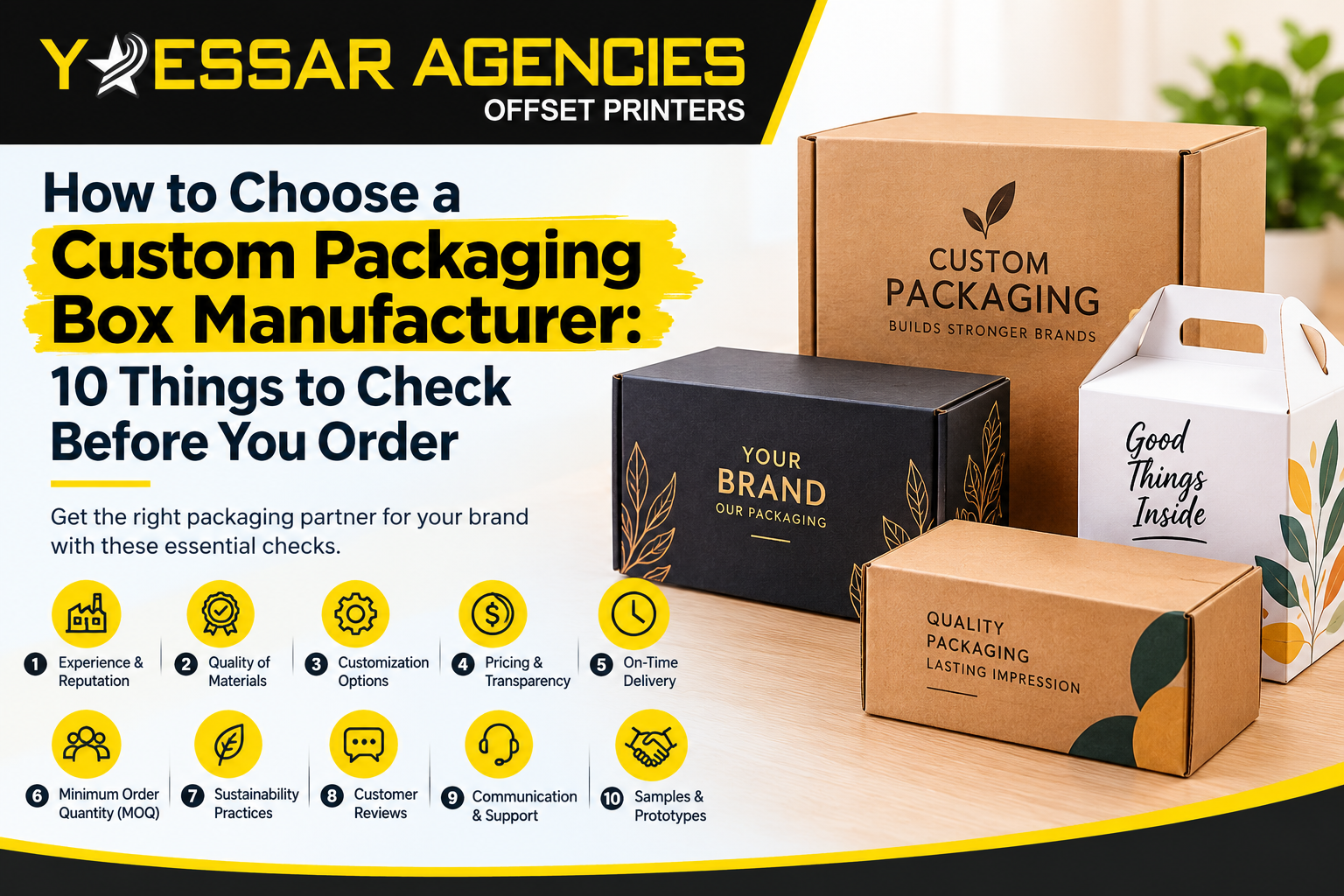
How to Choose a Custom Packaging Box Manufacturer: 10 Things to Check Before You Order
A packaging order goes wrong long before the cartons arrive, and usually at the moment someone picks a supplier on price alone. Custom packaging box manufacturers vary widely in board quality, print accuracy, tolerances and honesty about lead times, and those gaps show up as crushed corners, off-colour logos and missed launch dates. This guide lays out ten checks that separate dependable suppliers from risky ones.
To choose a custom packaging box manufacturer, check ten things: the board grades they stock, their printing method, colour control, sample policy, minimum order, lead time, quality checks, food-safety knowledge, finishing options and references. A supplier who answers each with specifics, not slogans, is far more likely to deliver cartons that match your approved sample.
Why Do Custom Packaging Box Manufacturers Differ So Much?
The biggest difference is whether a supplier prints and cuts in-house or simply resells someone else’s work. A manufacturer with its own offset presses and die-cutting line controls colour, timing and cost directly, while a trader adds a margin and passes your artwork to a third party. Both can deliver good cartons, but only one can tell you exactly what is happening on the press.
Region matters as well, because printing clusters concentrate skills and suppliers in one place. Sivakasi in Tamil Nadu is one of India’s best-known printing centres, and printers there can source board, plates and dies close to the press. Yessar Agencies, an offset printer based in the town, works inside that ecosystem.
Ten checks cover most of what goes wrong in a first order, and the table below shows what a good answer sounds like for each
| # | Check | What a good answer sounds like |
| 1 | Board grades | Names GSM and board type, such as FBB or duplex |
| 2 | Printing method | Sheet-fed offset for long runs, on its own presses |
| 3 | Colour control | Pantone matching and a stated Delta E tolerance |
| 4 | Sample policy | Printed or white dummy before the full run |
| 5 | Minimum order | A stated figure and the reason behind it |
| 6 | Lead time | Days counted from artwork approval |
| 7 | Quality checks | Inspection during the run, not only at the end |
| 8 | Food-safety knowledge | Virgin board, low-migration inks, FSSAI awareness |
| 9 | Finishing options | Lamination, varnish, UV, foil, embossing |
| 10 | References | Past clients you can contact |
How Do You Judge Board Quality, Printing and Colour?
Board quality is the first check, and the answer should be a grade and a weight, not an adjective. Reputable custom packaging box manufacturers will name the board, for example 300 GSM folding box board, and hand over a swatch. A vague reply such as ‘good quality card’ leaves room to swap in a cheaper sheet mid-order.
The printing method shapes both price and finish in custom box printing. Offset printing, where ink transfers from an aluminium plate to a rubber blanket and then to the sheet, suits runs of a thousand cartons or more because plates and dies cost money before the first carton prints. Digital suits very short runs, though its cost per piece is higher.
Colour control deserves its own question. Ask whether the printer matches Pantone shades, prints colour bars on every sheet, and works to a stated Delta E tolerance, the numeric gap between your approved colour and the printed one. A lower Delta E means a closer match, and a printer who can quote the figure has probably measured it.
What Should You Ask Before Approving a Sample?
A sample policy tells you how a supplier handles risk. A printed digital proof shows layout and colour approximately, while a white dummy cut on the actual die shows size, fold and fit. For a new carton shape, asking for both is cheap insurance against a ruined run. A die that is 2 mm off can leave a product that will not slide in.
Pre-press review is a quiet sign of a careful supplier. A printer that checks artwork for bleed, barcode size and fold placement before plates are made catches errors that cost nothing to fix on screen and a great deal on a press.
Quality checks during production matter more than inspection at the end. Ask who checks colour against the approved sheet, how often, and what happens to a sheet that drifts. A printer that pulls sample sheets at set intervals and keeps them can show you evidence when a batch is questioned.
Do Minimum Orders and Lead Times Match Your Plans?
Minimum order quantity is a cost question disguised as a policy. Most custom packaging box manufacturers set a minimum because plates, dies and press setup are fixed costs, and a good supplier can explain the figure in those terms. If a quoted minimum is far above what you need, ask whether a smaller trial run is possible and what it would cost per piece.
Lead time should be counted from artwork approval, not from the day you send an enquiry. A typical offset job moves through plate-making, printing, drying, die-cutting and gluing, and each stage waits for the previous one. Ask for a stage-by-stage schedule, and ask what slips first when festival orders fill the machines.
Reorders are the quiet part of lead time. Ask whether the printer stores your die and plates, how long it keeps them and whether storage carries a charge, because a stored die keeps carton dimensions identical from one batch to the next and trims setup time on repeat runs.
What Compliance and Track Record Should You Look For?
Food-safety knowledge separates packaging specialists from general printers. For food cartons, ask whether the board is virgin fibre and whether the inks are low-migration, because mineral oils in recycled board can transfer to dry foods such as biscuits and spices. Indian food packaging also falls under the FSSAI Packaging Regulations, 2018, so a printer should be able to say how its materials comply.
Finishing options deserve a quick look because they change both durability and recyclability. Gloss or matt lamination resists scuffs, aqueous varnish is lighter and easier to recycle, and spot UV, foil and embossing add shelf appeal at extra cost. Ask to see finished cartons with the same finish you plan to order.
References are the last check and often the most telling. Ask for two or three buyers in your own category, such as pharma, food or cosmetics, and call them. A single question works well: did the last repeat order match the first one? Consistency across reorders is what a printed sample cannot prove.
Common Questions About Custom Packaging
Is it better to buy from a manufacturer or a trader?
A manufacturer with its own presses usually gives tighter control over colour, schedule and price, because nobody sits between you and the machine. A trader can still make sense for small mixed orders, provided they tell you which printer handles the job.
How much does custom box printing cost?
Price rises with board weight, number of colours, finishes such as foil or UV, and carton size, and falls as quantity grows. Ask for quotes on the same specification from each supplier, otherwise the figures cannot be compared. A printer such as Yessar Agencies can quote exactly once it has your dieline.
What files do manufacturers need for custom box printing?
Most printers want a vector artwork file, usually PDF or AI, with fonts outlined, images at 300 dpi and 3 mm bleed beyond the cut line. A dieline from the printer, not a generic template, keeps the artwork aligned with the real folds.
What red flags should I watch for in a packaging supplier?
Watch for quotes that skip the board grade, refusals to share a sample, and delivery dates with no schedule behind them. A price far below every other quote usually means lighter board, fewer colours or skipped checks.
Can small brands order custom boxes without huge quantities?
Yes, though the minimum order will shape the cost per piece. Small brands often start with a standard dieline and a one- or two-colour print, then add finishes once volumes justify the setup.
Your Next Step Before Requesting Quotes
Choosing between custom packaging box manufacturers comes down to evidence, and every item in the table above produces some. Board grades, press ownership, tolerances and schedules are facts a supplier can state in writing, so treat any answer that stays vague as an answer in itself.
A practical way to start is to send the same short brief to three suppliers: carton dimensions, board preference, number of colours, finish, quantity and delivery date. Identical briefs produce quotes you can compare line by line, and the supplier who replies with questions about your product is usually the one paying attention. Printers in Sivakasi, Yessar Agencies among them, can work from a brief like this to quote a first run.
Good packaging is a quiet promise, and the supplier you pick decides whether it holds. Ask the awkward questions now, while a wrong answer costs only a phone call.